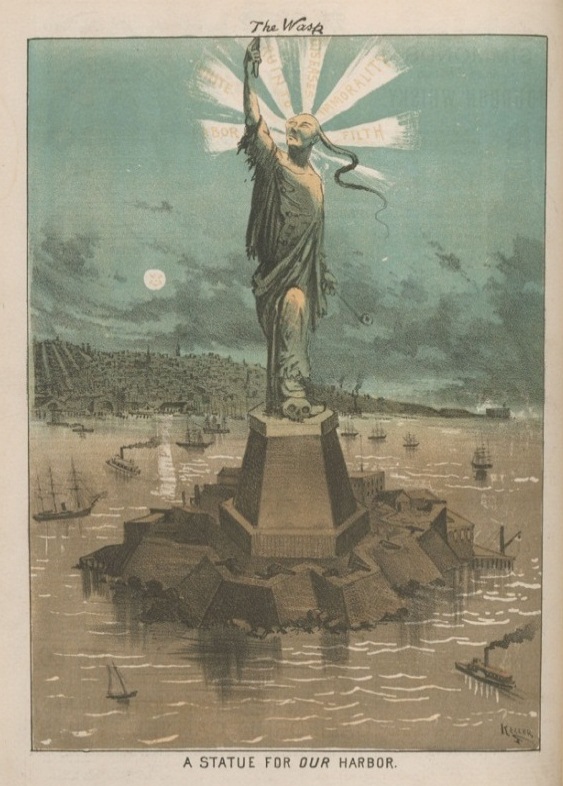
“A Statue for Our Harbor” 1881

Cartoon of Chinese man as a mockery of the statue of liberty “A Statue for Our Harbor” 11 November 1881 by George Frederick Keller for the San Francisco Illustrated Wasp

San Francisco artist George F. Keller struck again, aided by The Wasp’s increased investment in color lithography, with A Statue For Our Harbor, November 11, 1881. Although the Statue of Liberty and its base had yet to make a physical appearance in New York’s harbor, discussions about the statue and controversies in fundraising and artists’renditions, were broadly covered in East Coast media and beyond. Keller’s image serves as a reminder that he and or The Wasp kept their attention on their eastern counterparts and applied regional topics to switch focus on West Coast concerns. The image is a cry for attention to examine West Coast immigration issues.

The image was preceded by a popular book, The Last Days of the Republic (1880) written by newspaper editor Pierson Dooner who “described immigration as a “vicious conspiracy” against the U.S. by the Chinese, and illustrated his point with Keller’s drawings” (Tchen/Yeats, 231).

No warm welcome from a copper French Lady Liberty here — immigrants to San Francisco’s harbor are welcomed by a menacing Chinese effigy. His clothes in tatters, this slimy figure, with his long snakelike queue wafting with the breeze, illuminates the American way for Asian immigrants. A few steamboats rest in the harbor, but a larger number arrive via antiquated Asian sail boats or “junks.”

The implication is clear. Modern European immigration has acquiesced in deference to an infiltration of backward, invading forces from Asia.  A full moon with a Chinese likeness sneeringly supervises the scene. His celestial light bathes the night sky. Six beams of light emanate from the statue’s unseen torch or lamp. They illuminate the harbor with “Filth,” “Immorality,” “Diseases,” and requiring three beams,“Ruin to White Labor.”  In the statue’s other hand is an opium pipe. The Chinese man’s foot is triumphantly perched upon a human skull, presumably that of a white human, and behind the skull is a rat’s tail. The rodent has picked the skull clean.

The Wasp’s indoctrinated readers knew all too well that the Chinese ate rodents. Western press delighted in repeating the disgusting stereotype. In Keller’s illustration, the Chinese have ascended to the top of the food chain. A position that is complicit with the cannibalism of white humanity.  Rodents thriving along the embankment collect at the base of the star-shaped pedestal, strewn with trash.

While labor issues dominated one of the six categories  The Wasp repeated about the Chinese, the overarching theme in this image is one of disease and immorality. The Wasp suggests there can be no question that the Chinese are to blame for dark and dismal polluted condition of San Francisco’s harbor.

Light and dark divides the image. As a “celestial” the Chinese figure is awash in light as he extends his arm and face toward the source of his “otherness” the celestial sky.  The clouds part in his presence.  The colors darken as the figure connects with the earth and his roots and foundation into his new San Francisco home.
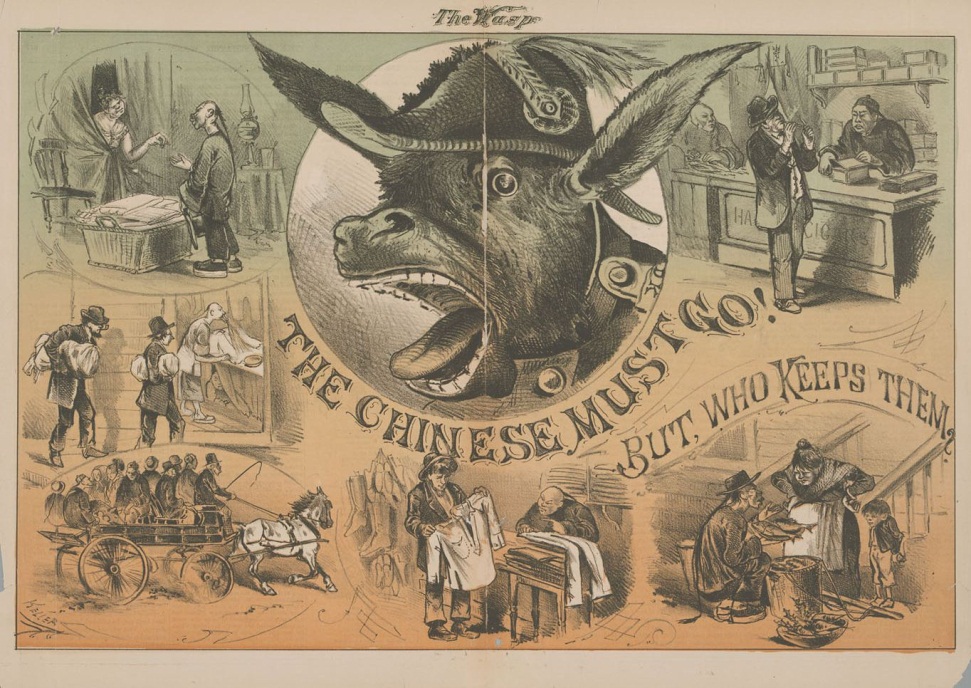
“The Chinese Must Go, But Who Keeps Them?” 1878

A donkey (Denis Kearney( honks as scenes of Chinese workers surround “The Chinese Must Go, But Who Keeps Them?” – 11 May 1878 by George Frederick Keller for The San Francisco Illustrated Wasp

The Chinese Must Go, But Who Keeps Them? was drawn by George F. Keller and published on May 11, 1878. The cartoon is The Wasp’s interpretation of the Workingmen’s Party’s rallying cry against Chinese presence in California.  Front and center is a donkey in military garb, an indication of a war–war against the Chinese, and liberal immigration policies. On the epaulets of the donkey’s uniform, the initials “D.K.” represent the faction’s self-styled military leader, Irish-born Denis Kearney and crier of “the Chinese Must Go” mantra.

Kearney, a charismatic Irish American “began his infamous outdoor “Sandlot” meetings on vacant lots…and understood how to turn rage about unemployment, the price of food, and the huge land grants to the railroads against the Chinese” (Pfaelzer 77).

The cartoon’s title question has a double meaning. Kearney and his Workingmen’s Party were clear on one goal. They wanted the Chinese out of California –out of the West Coast — out of the labor market.  Go back to China, go East — as long as they went. They cared little about who would take care of the Chinese afterward.

The title challenges the readers to look within. Who was taking care of the Chinese in California? Who was keeping them, enabling them, to stay in California? The Wasp pointed the finger at their readers.

Surrounding the braying Kearney, six vignettes show the consequences of white citizens patronizing Chinese business; a cigar shop, shoe cobbler, laundry, horse livery and meat butcher. All professions that the Chinese successfully established and sustained through white patronage. White dollars kept the Chinese in place.  By asking, “But who keeps them?” the cartoon places the blame directly upon white households.  The editorial called for widespread boycotts of Chinese goods and services.

White woman in California were reluctant to give up the freedoms they had enjoyed by subbing out the domestic work to Chinese businesses. “Their freedom to travel east, to visit friends and family, and their time for church and artistic clubs – all the result of inexpensive Chinese servants – was in jeopardy” (Pfaelzer 66).

As the 1873 economic collapse persisted well into 1876,  anti-Chinese zealotry organized into groups, such as the Supreme Order of the Caucasians, who vowed to “annihilate” white people who did not follow their “hit list” of boycotts (Pfaelzer 67).

However, the image is not entirely flattering to Irish-born Kearney and his followers. According to Richard Samuel West, The Wasp abhorred mob violence and the paper adopted the editorial position that while it believed in the true threat of Chinese labor at the expense of white labor, Kearney’s method lacked dignity.  Unlike Nast who drew Kearney’s realistically, The Wasp rarely used Kearney’s face in their magazines and in this particular instance, preferred to use the Democratic donkey in his place. “The animal appealed to illustrators for its jackass connotations” (Dewey 17).

Nevertheless, Kearney’s Sandlot speeches resonated with California Democrats and the working class who comprised Kearney’s Workingmen’s Party. “Just two years later, the new party managed to rewrite local anti-Chinese codes into the second California constitution” (Pfaelzer 78-79). Other anti-Chinese measures would follow in California, and loomed on the federal horizon. Back east, Thomas Nast took notice as he watched the Democratic Party gain influence over the electorate and contribute to the shifting public policy against the Chinese. To Nast’s horror, Republicans came under the influence, as well.

Nast drew numerous cartoons sympathetic to the Chinese’s plight in America. Many of his cartoons react to unfolding events in California. Nast included many references to Kearney in his cartoons, often sarcastically quoting him on wall posters.  See example: Every Dog (No Distinction of Color) Has His Day, February 8, 1879

It should be noted that Keller’s donkey wears a bicorn military hat. A few of Nast’s anti-Chinese cartoon figures contain a military figure wearing a bicorn hat. This may or may not serve as a symbol for Kearney. In the context of Nast’s cartoons, the suggestion seems plausible.


“What Shall We Do With Our Boys?” 1882

Satire cartoon of Chinese laborer working abnormally fast “What Shall We Do With Our Boys” – 3 March 1882 by George Frederick Keller for The San Francisco Illustrated Wasp

One distinctive feature of The Wasp was its use of color lithography. Korbel’s and Keller’s experience and expertise in color lithographs of cigar box labels and Korbel’s investment in its own printing equipment gave The Wasp instant appeal. An example of effective use of color can be found in What Shall We Do With Our Boys, March 3, 1882.

Clearly fixated on the labor issue, the cartoon incorporates two of West’ six themes favored by The Wasp: the Chinese as ruthless competitors and subversive labor monsters.

The frame is divided, two-thirds occupied and dominated by an eleven-handed Chinese worker-monster. “The Chinese were depicted as “many handed” or monstrous creatures depriving white labors of their jobs” (Choy 84). Keller’s uber-octopus like Chinese laborer is seen going to town, a busy industrial whirlwind of labor productivity. He is unstoppable in the trades and crafts most attributed to Chinese workers; shoemaker, tailor, cigar maker and laundryman that testify to his industriousness. Collectively, his array of hands holds a saw, mallet, hammer, and brush.

Most dangerous of all, he is succeeding. Two hands are busy socking away a substantial bag of money and assures the satchel is carted off in a rickshaw to export “For China.”  “Chinese Trade Monopoly” is secured in place with his foot. The image emphasizes the prevailing anti-Chinese view that the Chinese aren’t like other immigrants. They are instead “sojourners” whose only wish is to make money in America to send back to their families in China.  The cartoon does not reference the fact that the Chinese were legally restricted from becoming naturalized citizens.

In the event the viewer does not fully appreciate the implications of this Chinese monster, the remaining third of the screen, clean shaven, non-threatening white boys collect on a street corner with nothing to do, loitering outside. These are not angry Irish boys. They are victims of the Chinese menace. These young men are well dressed, with jackets and hats. They bear pensive expressions – chins resting on hands. One young man leans on a lamppost with an American Eagle on top, and another leans against the side of the one-man Chinese factory. Without a future, they are, as the caption points out “our boys” – children of the readership. A police officer leads one of the loiterers away to one of three structures in the distance.  What path lies in the boy’s future? What fate? Institutions in the distance provide the grim answer, “San Quentin,” “Industrial School,” or “House of Correction.” The message is clear. The Chinese labor problem erodes an opportunity for wholesome, American boys to obtain honest work. They cannot compete with the whirlwind of cheap, Chinese labor. Inside, the Chinese phenomenon could care less. Keller imbues him with a gleeful, sinister expression as he monopolizes and spins profits.

The Chinese worker’s face is grotesquely distorted. His eyes are deeply slanted, his crooked smile missing several teeth, digs crevices that form a malevolent expression.  His queue rises in mid-air, curled like a whip, propelled by the frenzy of his windmill-like hands.

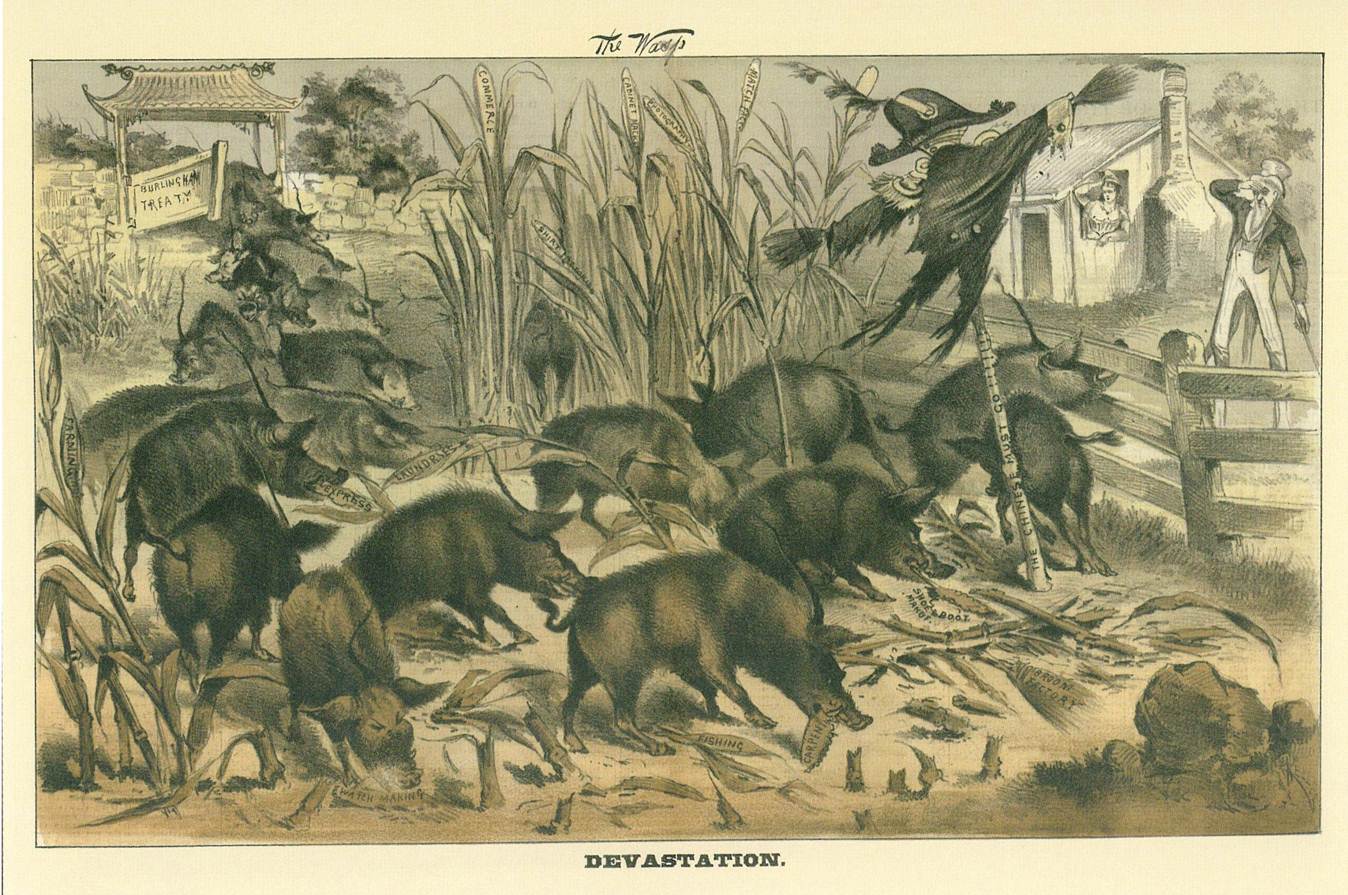
“Devastation” – 2 October, 1880

cartoon showing Chinese as pigs devouring a farm “Devastation” 2 October 1880 by George Frederick Keller, The San Francisco Illustrated Wasp

George Frederick Keller used the invasion theme once again with the Burlingame Treaty as the subject. West called Keller’s Devastation, October 2, 1880  “the best drawn of the many cartoons that Keller created decrying Chinese immigration…The tattered ineffectual scarecrow is Denis Kearney, the leader of the Workingmen’s Party”(148).

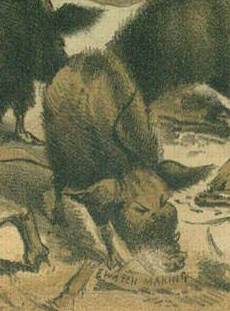
Detail of Keller's Chinese pigs in Devastation Detail of Keller’s Chinese pigs in Devastation

Instead of insects used in Uncle Sam’s Farm is in Danger, here the Chinese immigrants are dehumanized and represented as pigs bursting through an Asian gateway, named “Burlingame Treaty.” The brown, hairy, porcines with Chinese faces make a bee-line toward Uncle Sam’s cornfield, and devour everything in sight.  In addition to their tails,  a queue grows from the back of each of the pig’s head. Cornstalks, represent the job-rich industries of “watch making,” “laundries,” “shirt factories,” “broom factories,” and “cabinet makers,” to name a few, that fall victim to the crunching, ravenous appetite of the pestilent pigs.

Kearney’s scarecrow is left in tatters. He swings around a pole emblazoned with “The Chinese Must Go!!!!!!!”  Uncle Sam, exasperated,  watches from his lawn on the other side of his fence.  Columbia peers out a window of their modest American home. Both she and Uncle Sam are minimized, weak and ineffectual. The Chinese have caused utter devastation.

Employing agricultural symbolism to suggest that the Chinese would destroy California agriculture is deeply ironic. California agriculture owed a great deal to Asian Americans.

Ronald Takaki explains that the Chinese were at the very center of California’s success as an agricultural producer.  “Their work boosted the value of the land from twenty-eight dollars an acre in 1875 to one hundred dollars an acre two years later” (89).

As livestock animals, pigs or hogs were considered the lowest form of animal because of their greedy, rooting nature (McNeur 641). In the early nineteenth century, particularly in New York City, hogs were believed to be the carriers of disease and pestilence.

“Swine were closely tied to the filth and unpleasant smells that characterized the streets and public places of the city. Hogs and garbage, after all, went hand in hand” (McNeur 643). It is not unreasonable that these attitudes traveled westward.  Comparing the Chinese to swine helped to define them as “others” and cement a perception that the Chinese were unsanitary and disease ridden – a pervasive stereotype attributed to the Chinese.

Bibliography of quoted sources.

“Uncle Sam’s Farm in Danger” 9 March, 1878

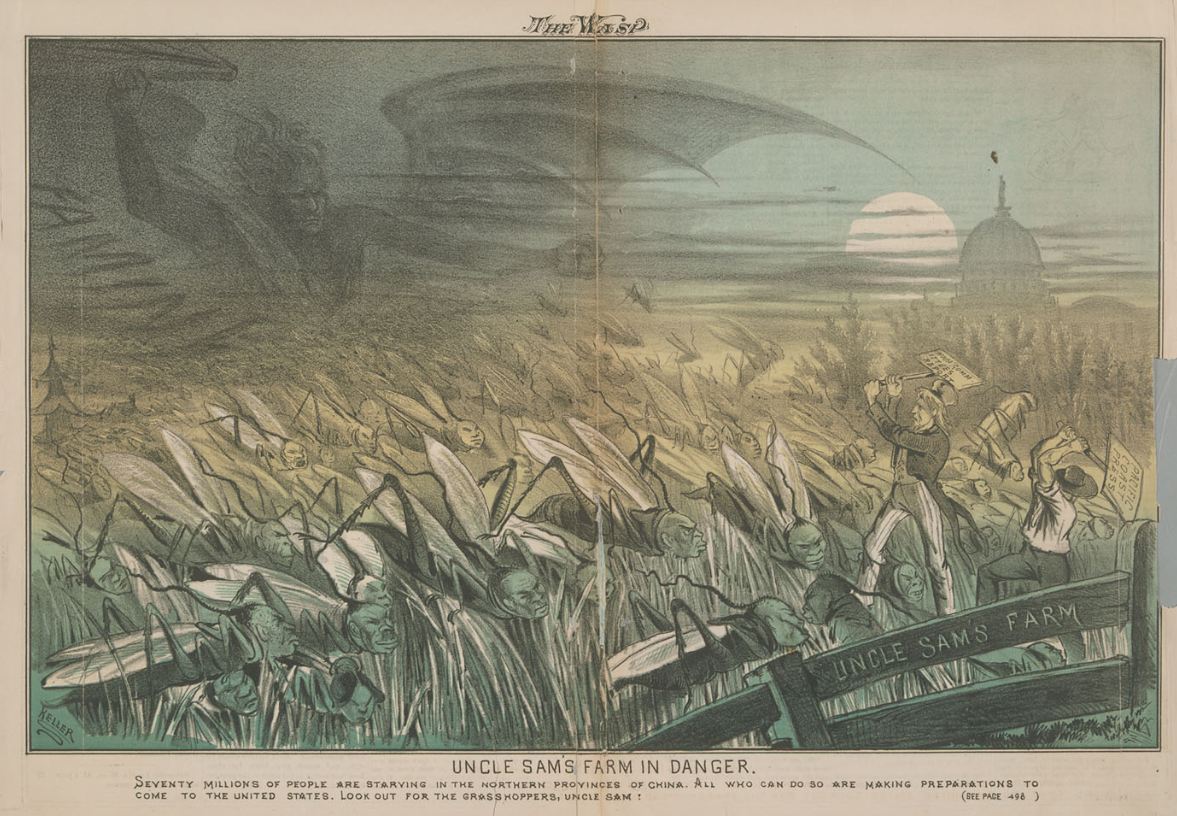
Chinese drawn as locusts invading a farm “Uncle Sam’s Farm in Danger” The San Francisco Wasp by George F. Keller. 9 March 1878

George F.Keller’s 1878 piece, Uncle Sam’s Farm in Danger adopted and mastered classic invasion imagery and animal symbolism to devastating effect.

Swarms of Chinese locusts descend on an American farm, Uncle Sam’s farm, no less. The insects, perched for destruction, have sinister Asian faces. The editorial accompanying this double-page pictorial in the Wasp’s March 9, 1878, issue states in part,

Our artist has represented the possible immigration as a swarm of grasshoppers driven along by the inexorable hand of Famine…Uncle Sam, armed with the House Committee Resolutions, assisted by his hired man, the California Press, is striving to stay the torrent of yellow grasshoppers. It seems almost impossible for them to succeed; and it is certain that they will be overcome by the invader unless assistance of a more substantial kind be rendered” (Wasp 498).

The image is disturbing. Precisely what The Wasp had hoped to achieve. With this image, Keller perfected the technique of invasion/infestation imagery.

As the caption and supporting article made clear, The Wasp stoked the fear that widespread famine in China would drive millions of additional Chinese to emigrate to America. Something was needed to stop this danger! The Wasp knew exactly what fear-mongering buttons to push.

An uphill battle faces Uncle Sam as he fights off this swarm. Meanwhile, the dark, ghoulish specter of Chinese famine ushers in and emboldens new invaders to feast on an American bounty while the getting is good.

While full color was available and used, Keller limits the color to gloomy tones of grey, blue, green and brown. The color choices add to the overall affect of doom.

The caption reads “Seventy Millions {sic} of people are starving in the northern provinces of China. All who can do so are making preparations to come to the United States. Look out for the grasshoppers, Uncle Sam.”

Evoking this particular insect symbolism was a clever choice to grab attention and arouse the emotions of Californians whose livelihood depended on the continued success of the agricultural sector.  The grasshopper was acutely feared in California’s agricultural community. In 1828 a grasshopper plague caused near famine, and in the great plague of 1874-1878, the crop-munching insect was responsible for the wide-spread destruction in the Midwest, causing western governors to organize days of prayer to keep the tide from coming westward (Schlebecker).

“California was the locus of Chinese advances in agriculture” (Takaki 89). The Chinese were the anthesis of greedy locusts.The irony of course, is that California’s agriculture success was cultivated and directly benefited from the transformative innovations contributed by the Chinese. “Their work boosted the value of the land from twenty-eight dollars an acre in 1875 to one hundred dollars an acre two years later” (Takaki 89). Keller also used agricultural imagery in his cartoon Devastation.

For an example of Nast using invasion imagery, see his “The American River Ganges

“The Balky Team” – 16 February, 1879

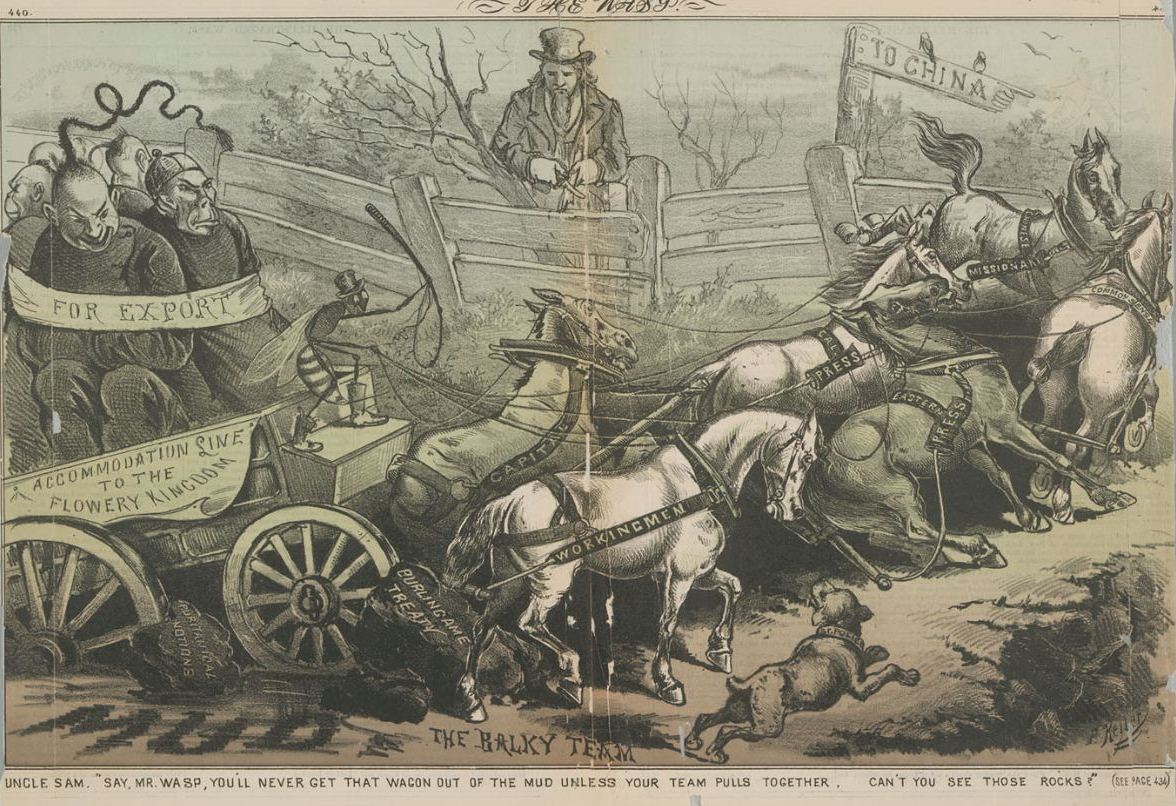
Satire cartoon of chinese bound in a wagon drawn by horses “The Balky Team” 16 February 1879 by George Frederick Keller

Like Nast,The Burlingame Treaty factored as an ingredient in Keller’s work. In The Balky Team on February 16, 1879, the treaty is represented as a small boulder, an obstacle to be overcome with the concerted efforts of the united horsepower trio named Common Sense, California Press, and the Workingmen’s Party.  But there is trouble in the mix—some powers of influence–the horses representing the Chinese Missionaries, a “balky” Eastern Press and Capital, resist the plodding ahead to export sinister looking Chinese, bundled as cargo, back to China. Uncle Sam warns the wagon master, a wasp (the magazine’s mascot), to get his team in order. Only a unified purpose can achieve progress beyond “puritanical notions” of East Coast sentiments.

The Wasp editor reveled in the reviews from California papers that called this an “excellent cartoon” that depicted The Wasp’s efforts to haul the entire Chinese population out of the country. “It is a source of no small gratification” the editors wrote. “The Wasp is creating a sensation in newspaper circles” (The Wasp, Feb. 16, 1878).

Keller employed effective techniques such as animal symbolism to manipulate public sentiment.  Keller may have  borrowed a lesson or two from Nast. Nast was featured and lampooned a few times in The Wasp. When asked if Nast influenced Keller, Richard Samuel West responded,

“I’m sure you are right that Keller was looking at Nast’s work (and Puck), but I very much doubt Nast saw anything but a random cartoon from The Wasp.  It was not available on New York newsstands.  There is one Keller cartoon from the spring of 1880 in which he drew Nast and Puck (with their hair in queues) going through San Francisco’s garbage.  That’s the only cartoon that comes to mind where Keller and The Wasp explicitly commented on their New York rivals. (West email)